
The global digital economy runs entirely on complex infrastructure, distributed cloud environments, and intricate data systems. However, even the most revolutionary software application or enterprise architecture is functionally useless if the target audience cannot understand how to configure, deploy, or scale it.
That structural gap is exactly where technical content writing saves the day.
Technical content writing is the art and science of translating dense engineering realities, algorithmic frameworks, and enterprise software systems into clear, actionable, and highly authoritative educational assets. It bridges the gap between raw developer code and executive business decision-making. Before mastering the niche of technical execution, it is critical to step back and analyze what content writing is in its broadest structural form.
While the fundamentals trace back to shifts observed during the evolution of content writing in 2022, the current corporate ecosystem demands significantly deeper subject matter specialization.
The Core Spectrum of Technical Content Architecture
Technical writing is not a singular, uniform discipline. It is a diverse spectrum of content styles designed to address distinct audiences within the corporate lifecycle, ranging from backend DevOps engineers to chief technology officers.
Developer Documentation and API Manuals
The foundational layer of technical content involves creating precise, error-free documentation for developers. This includes building comprehensive API references using platforms like Postman and Swagger, detailing SDK integrations, and providing clean, reproducible code blocks in languages like JavaScript, Python, or Go. In this domain, ambiguity is an architectural failure. A single displaced character or an unannounced breaking change in an API endpoint can stall an entire enterprise deployment pipeline.
Enterprise Whitepapers and Solution Briefs
At the higher end of the corporate funnel, technical writers create authoritative whitepapers that outline how specific platforms resolve massive operational inefficiencies. For instance, an organization deploying a process intelligence platform like Celonis or a complex enterprise resource planning ecosystem like SAP requires content that explains structural process mining, data ingestion pipelines, and system transformations. This content targets enterprise architects and technology executives who need to understand the underlying technical mechanics before approving multi-million dollar procurement cycles.
Data Governance and Intelligence Strategy
Modern businesses handle massive data lakes, making clear documentation around data discovery and lineage a critical compliance necessity. Technical content writers collaborate with data teams to draft clear guides regarding how platforms like Alation build unified data catalogs. This documentation outlines how metadata is tagged, how data stewardship is governed, and how business teams can safely query internal systems while maintaining absolute compliance with global data privacy frameworks.
Read more: To understand the critical importance of platform independence when building a professional brand, explore our breakdown on website freedom.
The Modern Technical Content Writer’s Software Stack
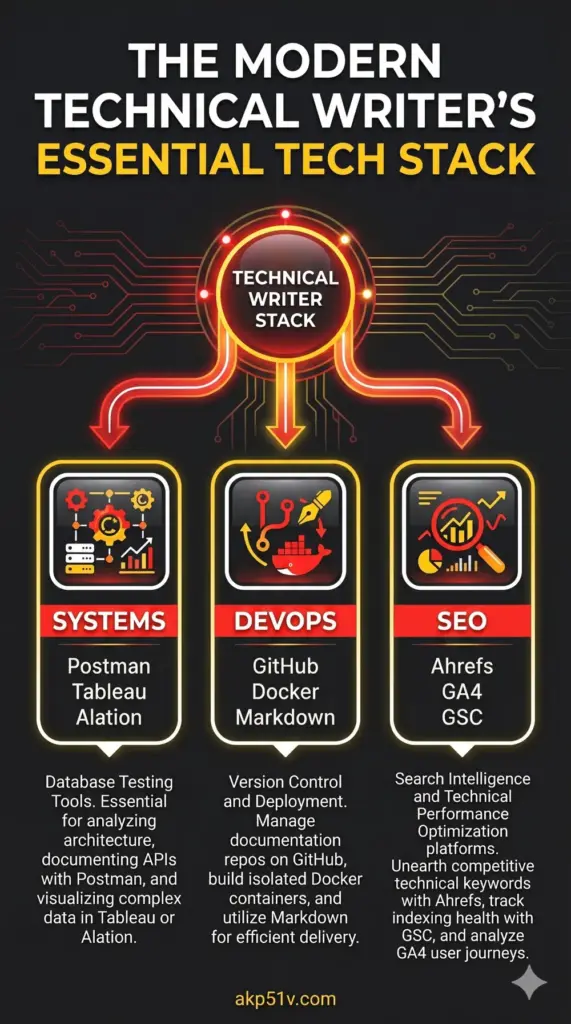
To build authority in competitive corporate niches, a technical writer must look past basic text editors. Operating effectively requires a modern, functional tech stack designed to analyze systems, manage documentation repositories, and optimize search performance.
Infrastructure and API Testing Systems
- Postman & Swagger: Essential software environments used to interact with REST APIs, verify JSON payloads, validate response codes, and construct accurate, functional documentation parameters.
- Tableau & Alation: Powerful data visualization and data catalog software used to analyze information patterns, map out enterprise data dictionaries, and document analytics dashboards for business intelligence teams.
DevOps and Containerization Tracking
- GitHub: The industry-standard version control platform where technical writers manage markdown documentation files, handle pull requests, and collaborate directly with product engineering teams.
- Docker: Used by advanced technical writers to set up localized containerized environments, ensuring that step-by-step setup guides operate perfectly across isolated machine states.
Search Intelligence and Performance Optimization
- Ahrefs & Google Search Console: Enterprise analytics platforms utilized to conduct deep competitive research, unearth semantic search intents, map structural keyword landscapes, and audit indexation health.
On-Page SEO Architecture for Technical Content Writing Ecosystems
An exceptionally accurate guide offers no corporate value if it remains buried on page five of search results. Technical content must be built using robust on-page search engine optimization architectures to ensure it reaches its intended technical audience.
This process requires familiarity with specialized content writing & SEO tools to optimize documentation structure, maximize semantic relevance, and ensure clean crawling patterns, while entirely avoiding unnatural keyword stuffing by maintaining a mathematically sound approach to keyword density metrics. The structural presentation must prioritize clear headings, logical transitions, and dense information blocks over superficial word length. Since those actions demand stripping out bloated phrases, content writers must prepare and use a structured compilation of wasteful words or fluff.
Addressing Hardware-Level and Privacy Realities
Technical content ranges across diverse infrastructural domains.
- You can explain hardware security baselines, like verifying a computer TPM version for Windows 11, or teach designing architecture diagrams.
- Similarly, think about current events in compliance, governance, standardization, and data localization. For instance, a technical blogger or thought leader can provide a detailed, actionable, and highly educational list of online privacy protection methods for end users.
- On the other end of that discussion, you will find brands confused about what to do when tracking scope shrinks due to the ongoing shift toward privacy-first systems. That is a desirable audience seeking a guide on cookieless marketing strategies and frameworks.
Read more: Before attempting to scale your platform’s organic footprint, read our guide on backlinking precautions and critical metrics to safeguard your search rankings.
Technical Content Writers’ Career Metrics and Job Expectations
The corporate demand for high-tier technical content specialists is reaching historic highs. Enterprises realize that clear documentation directly lowers customer support tickets, shortens sales cycles, and drives developer adoption rates.
Technical Content Specialist Compensation Brackets
Salaries within the technical content engineering domain reflect the deep specialized knowledge required to interpret advanced systems accurately.
| Professional Experience Level | Common Corporate Designations | Estimated Salary Range (Annual USD) | Technical Skill Requirements |
|---|---|---|---|
| Junior Level (0–2 Years) | Technical Copywriter, Documentation Associate | $60,000 to $80,000 | Basic Markdown, HTML/CSS, Git, Basic API Navigation |
| Mid-Level (2–5 Years) | Technical Content Specialist, Developer Advocate | $85,000 to $115,000 | REST APIs, Postman, SQL, Core Scripting (Python/JS) |
| Senior Level (5+ Years) | Enterprise Content Architect, Principal Technical Writer | $125,000 to $175,000+ | Headless CMS, Cloud Architecture (AWS/Azure), Process Mining |
Core Enterprise Deliverables
A modern technical writer’s corporate responsibilities reach far beyond simply generating text documents. Key deliverables include managing centralized documentation hubs, maintaining unified style guides, auditing outdated technical tutorials, and reviewing software product update logs. In technical reporting, arriving at conclusions too fast is dangerous because unverified metrics can ruin backend code deployments. Every step, parameter, and dependency must be manually tested and validated against live staging environments before customer-facing publication.
The Psychology of High-Authority Content Production by Technical Content Leaders
Maintaining high production output across complex technical domains requires deep mental discipline, structural planning, and an uncompromising commitment to factual verification.
- Building topical authority requires continuous execution, proving that consistency is easy to spell out but difficult to adhere to over long professional cycles.
- A dedicated writer understands that enthusiasm is infectious and so is the sloth, meaning project momentum must be intentionally maintained even when analyzing tedious, dry software logs.
- Maximizing the individual human potential to unlock true technical clarity is not possible if most of the technical content team members disagree on key workflows and concepts.
- Even when stepping away from dry technical text for a light, creative break, such as crafting a casual write-up about the planet Earth, structural clarity remains paramount.
The mindset used to organize an analytical breakdown of natural systems is the exact same mental framework used to map out enterprise cloud infrastructure components.
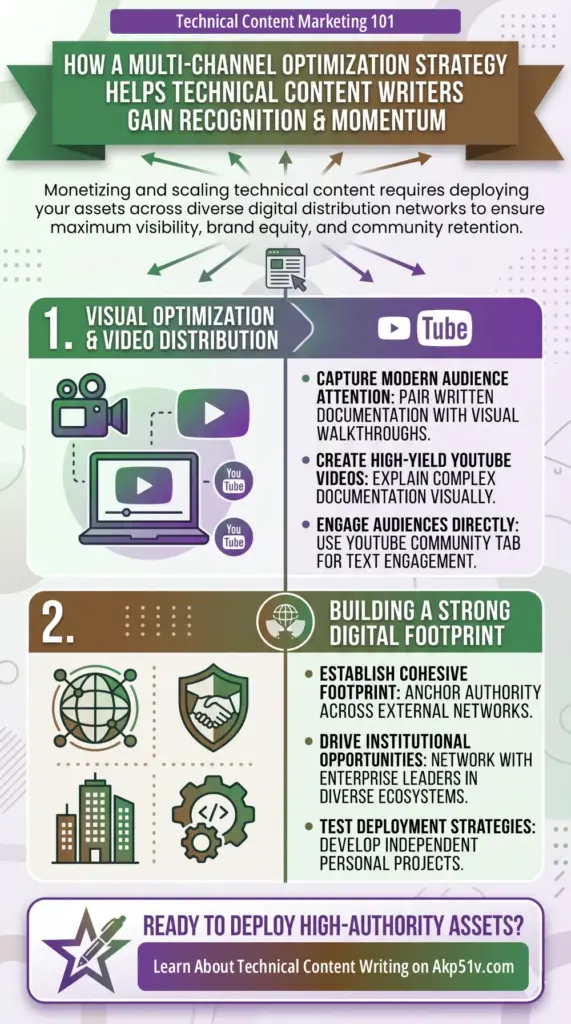
How a Multi-Channel Optimization Strategy Helps Technical Content Writers Gain Recognition & Momentum
Monetizing and scaling technical content requires deploying your assets across diverse digital distribution networks to ensure maximum visibility, brand equity, and community retention.
Visual Optimization and Video Distribution
Pairing written documentation with visual walkthroughs forms a powerful approach for capturing modern audience attention. This includes brainstorming high-yield YouTube video ideas to explain complex documentation visually, while keeping audiences updated once they have a YouTube Community Tab available for direct text engagement.
Building a Strong Digital Footprint
A technical writer must establish a cohesive, professional footprint across external networks to anchor authority and drive institutional consulting opportunities. Engaging actively across diverse ecosystems allows you to network with enterprise leaders, while continuously testing new deployment strategies across independent personal projects.Read more: If you are looking to deploy high-authority assets for your enterprise platform, consider exploring our premium content writing services.
Frequently Asked Questions
Can artificial intelligence tools completely replace human technical content writers?
No. While generative AI models generate generic text rapidly, they cannot independently log into an isolated staging environment, run Postman API tests, or verify structural engineering outcomes. Technical writing requires empirical verification and hands-on system testing, areas where automated models consistently experience factual errors.
What is the core difference between copy and technical writing?
Traditional copywriting focuses on emotional resonance, psychological triggers, and persuasive messaging designed to drive immediate transactional actions. Technical writing focuses on absolute factual clarity, logical precision, systemic instruction, and educational utility.
How do I build a technical portfolio without corporate experience?
The most effective strategy is to document your personal engineering and web development experiments. Create deep-dive setup guides for open-source systems, write clear API reference documentation for public tools on GitHub, or publish breakdowns of network privacy setups on your independent web platform.
What to Do Next?
Mastering technical communication requires a continuous investment in learning new developer tooling, cloud systems, and data management architectures. To explore deep-dive strategies regarding scaling your digital media platforms and optimizing content distribution frameworks, check out the comprehensive knowledge updates available across the unified Akp51v Content ecosystem over at:
- The (official) Main YouTube Channel
- The real-time Akp51v X Microblog
- My visual Instagram Hub
- My LinkedIn Professional Profile.
You can also browse curated collections on the Akp51v Pinterest Boards and access the secondary archival notes via the My Blogspot Repository.
All the best with your content journey. – Akp51v (AK Patil)